Web application architecture continues to evolve rapidly, integrating advanced technologies like AI, edge computing, and microservices to deliver faster, more secure, and highly scalable digital experiences. As organizations strive to keep pace with these changes, understanding the latest trends and best practices becomes essential for designing resilient, future-proof systems. This guide explores the core components of web architecture, the role of AI, emerging trends, and practical strategies to build robust web applications in 2026.
From foundational concepts like multi-tier architectures to cutting-edge innovations such as growth-driven design and serverless deployment, this comprehensive overview provides a clear roadmap for developers, architects, and stakeholders aiming to optimize their web infrastructures. Whether you’re constructing a new app or upgrading an existing system, mastering these principles ensures your web solutions are scalable, secure, and aligned with modern technological advancements.
Defining Web Application Architecture
A web application architecture is a blueprint detailing how various software components—such as databases, applications, and middleware—interact to deliver a seamless user experience. It establishes the data flow protocols, communication standards, and security measures necessary for reliable operation. The architecture also ensures that client-side interfaces and backend servers can communicate effectively, managing data validation, access control, and authentication processes.
Selecting an appropriate architecture influences your company’s scalability, reliability, and ability to adapt to future IT needs. Modern trends, such as generative AI and edge-native patterns, are increasingly shaping how developers structure web apps, enabling real-time, intelligent functionalities at scale. For a deeper dive into these concepts, check out the comprehensive resource on web architecture fundamentals.
AI’s Transformative Role in Web Architecture
Artificial Intelligence is fundamentally reshaping web application design by automating tasks, enhancing personalization, and supporting scalable operations. Client-side AI, exemplified by Microsoft’s Edge browser API that allows running sophisticated models like Phi-4-mini directly in the browser for on-device processing, exemplifies this shift. This approach minimizes latency and reduces server load, creating more responsive user experiences.
Edge computing further complements this trend by executing AI workloads closer to users, ensuring instant, context-aware interactions without over-reliance on centralized servers. Developers are embedding AI at every layer—front-end, middleware, and back-end—through adaptive UIs, AI-powered chatbots, and scalable ML pipelines. To understand how these integrations work, explore the role of JavaScript in modern web design.
Organizations that realign their architectures with AI capabilities can achieve more efficient scaling, deliver hyper-personalized experiences, and automate routine processes, gaining a competitive edge in innovation. As AI continues to advance, its integration within web architecture will be pivotal for future growth.
Core Components of Web Application Architecture
Traditional Web Architecture
A typical setup comprises three primary elements:
- Web Browser: The client-side interface where users interact with the application, validate inputs, and receive visual feedback.
- Web Server: Handles business logic, processes requests, and manages application operations, often running on platforms like Apache or NGINX.
- Database Server: Stores and retrieves data, supporting the application’s informational needs.
Understanding the 3-Tier Model
The 3-tier architecture separates an application into:
- Presentation Layer (Client): The user interface, often built with HTML, CSS, and JavaScript frameworks like React or Vue.js.
- Application Layer (Business Logic): Processes requests, orchestrates workflows, and may include AI inference, APIs, and microservices.
- Data Layer: Manages data storage using relational (SQL) or NoSQL databases, supporting structures like PostgreSQL, MongoDB, or graph databases.
This separation enhances security, scalability, and maintainability. For instance, deploying application servers on multiple machines allows horizontal scaling, ensuring high availability and load balancing.
Layers in Modern Web Architecture
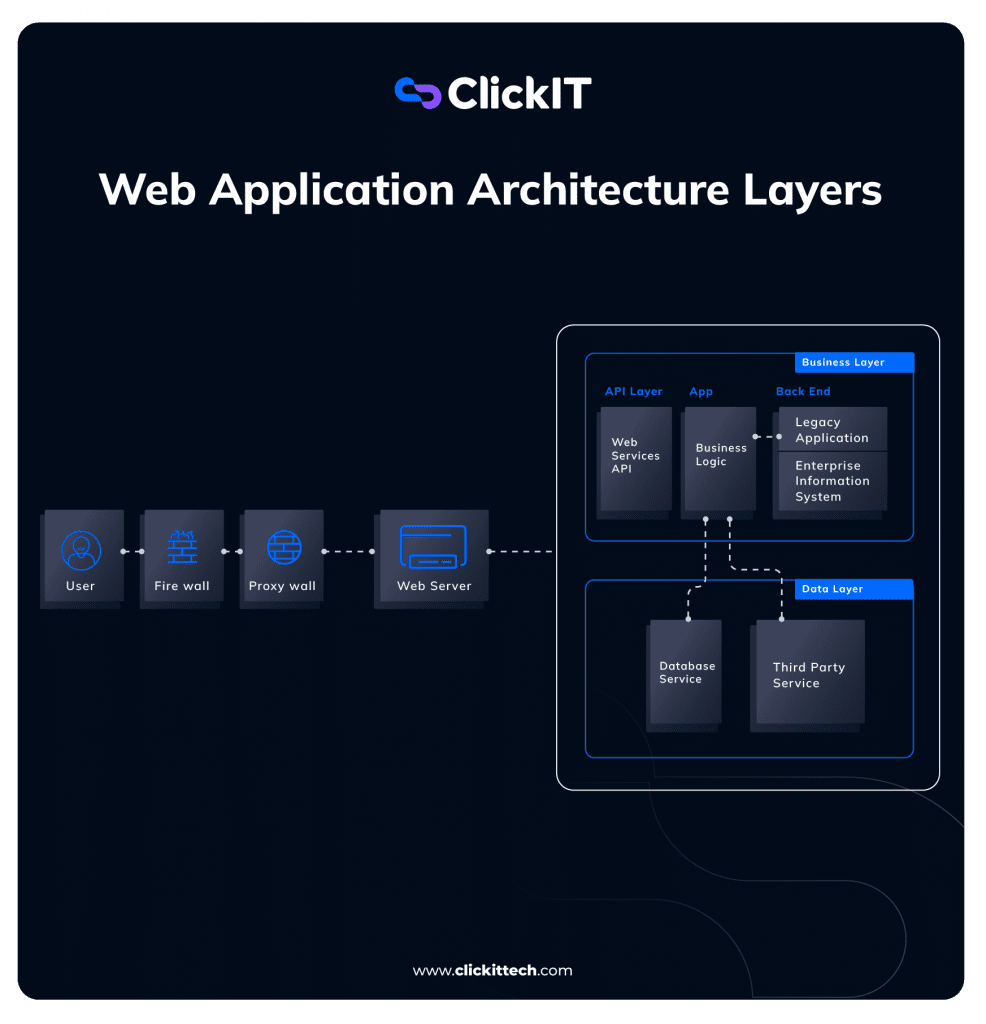
A layered approach facilitates modular development and easier maintenance. Typical layers include:
- Application Layer: Web servers, APIs, and AI inference engines.
- Presentation Layer: Front-end frameworks and client-side code.
- Data Layer: Databases and storage solutions.
- Cloud & Infrastructure Layer: Cloud instances, CDN services, load balancers, and message queues.
An example diagram illustrating these layers can be found here.
Key Technologies in the Application Layer
Web Servers: Apache, NGINX, and Caddy
Web servers are the backbone of application delivery. Apache’s modular design and support for dynamic content make it versatile, while NGINX’s event-driven architecture offers high performance and scalability. Caddy simplifies SSL management and configuration.
Front-end Technologies
The client-side interface leverages HTML, CSS, and JavaScript, with frameworks like React, Vue.js, or Angular enabling dynamic, responsive UIs. Modern browsers support on-device AI inference via APIs, further enhancing user experiences. For example, WebGPU enables real-time personalization directly within browsers.
Back-end Technologies
Popular server-side tools include Node.js, Python (Django, Flask, FastAPI), Java, PHP with Laravel, and Go. These frameworks facilitate scalable microservices, AI integration, and cloud-native deployment. For instance, Node.js’s event-driven model supports data streaming and real-time applications, while Python’s ecosystem excels in AI/ML workloads.
API Design
APIs act as mediators between components. RESTful APIs, GraphQL, and gRPC are common standards, enabling decoupled, scalable interactions. They allow rapid development, integration, and independent scaling of services. For example, API management tools streamline deployment and security.
Cloud & Infrastructure Components
Cloud instances, whether AWS EC2, Azure VMs, or Google Cloud, provide flexible hosting solutions. Cloud storage options like Amazon S3, Azure Blob Storage, and Google Cloud Storage support scalable data management. CDNs such as CloudFront or Azure CDN reduce latency and improve content delivery, while load balancers distribute traffic efficiently.
Message queues like Amazon SQS, Kafka, or RabbitMQ enable asynchronous communication, supporting decoupled microservices architectures. Implementing these components ensures a resilient, scalable, and efficient web system.
Trends Shaping Web Architecture in 2026
AI-First Architectures
AI-driven personalization, automation, and generative content creation are now integral to web systems. Edge AI processing reduces latency for real-time features, while AI models embedded in browsers—such as Phi-4-mini—enable on-device inference. Integrating AI across the stack enhances user engagement and operational efficiency.
Caching and Content Delivery Optimization
Advanced caching strategies—application server cache, distributed cache, and CDN—reduce server load and latency. Combining these with intelligent cache invalidation ensures fresh content delivery. For example, CloudFront enhances web performance by caching static assets globally.
Cloud Storage & Data Management
Cloud storage solutions are vital for scalable data management. AWS S3, Azure Blob, and Google Cloud Storage offer high durability, security, and regional availability. Their integration with CDN and load balancers optimizes content delivery to global audiences.
Serverless & Microservices
Serverless architectures, powered by AWS Lambda, Azure Functions, and Google Cloud Functions, enable event-driven scaling with minimal infrastructure management. Combining serverless with microservices—deployed via containers or orchestration tools like Kubernetes—supports flexible, cost-effective development.
Infrastructure as Code (IaC)
Tools like Terraform and AWS CloudFormation automate resource provisioning, ensuring consistency and reducing manual errors. IaC accelerates deployment cycles, facilitates testing, and simplifies rollback procedures—crucial for maintaining high availability.
Best Practices for Modern Web Architecture
- Scalability: Use horizontal scaling, container orchestration, and auto-scaling groups.
- Security & Compliance: Implement HIPAA, PCI DSS, and SOC2 guidelines to protect data.
- Automation: Deploy CI/CD pipelines for rapid, reliable releases.
- Immutable Infrastructure: Use version-controlled images for quick, predictable deployments.
- Multi-tenant Design: Adopt SaaS-friendly models to optimize resource utilization.
- Monitoring & Analytics: Integrate tools like CloudWatch or Application Insights for real-time insights.
Frequently Asked Questions
-
What are common models for web application components?
Single database with a web server for small apps, multiple web servers with a central database for scalable systems, or distributed databases for high-availability architectures. -
How does architecture differ from design?
Architecture describes high-level structure and component interaction, while design focuses on detailed implementation and code-level considerations. -
What is MVC architecture?
Model-View-Controller divides an application into three interconnected components, enhancing separation of concerns and maintainability. -
How do caching systems improve performance?
By storing frequently accessed data temporarily in fast-access memory, caching minimizes database load and reduces response times. -
Which tools are essential for managing web architecture?
Cloud platforms like AWS, infrastructure as code tools such as Terraform, frontend frameworks like React, backend frameworks, and DevOps tools like Docker and Kubernetes.
Building a resilient, scalable, and intelligent web application architecture in 2026 demands a comprehensive understanding of evolving components, cloud-native practices, and AI integrations. By adhering to these guidelines and staying attuned to emerging trends, organizations can deliver innovative digital experiences that stand the test of time.